Booked, Paid, and Still Overwhelmed?
You got the booking.
The fee is negotiated, the contract is signed, and the keynote is officially on your calendar.
That’s the part of the speaking business everyone sees. However, what they don’t see is what happens next.
The event planner needs your bio and headshot. Meanwhile, your AV requirements are due, a pre-event call needs to be scheduled, and travel arrangements need to be confirmed.
In addition, your introduction needs to be sent. There are deadlines to track, questions to answer, changes to manage, and details that must come together before you step onto the stage.
Finally, there is the follow-through after the event.
One engagement may be manageable. But what happens when you’re managing three, five, or ten?
That’s when successful keynote speakers often discover something nobody warned them about:
The more booked you become, the more work you create behind the scenes.
The problem isn’t your keynote. In fact, it isn’t a lack of talent either.
Instead, your speaking business may have simply outgrown the way you’re operating it.
That’s where Speaker Operations comes in.
What Is Speaker Operations?
Speaker Operations is the behind-the-scenes management of everything surrounding a professional speaking engagement.
In other words, it covers what happens between signing the contract and completing the follow-through after the event.
Your audience sees what happens onstage. However, your event planner experiences everything surrounding it.
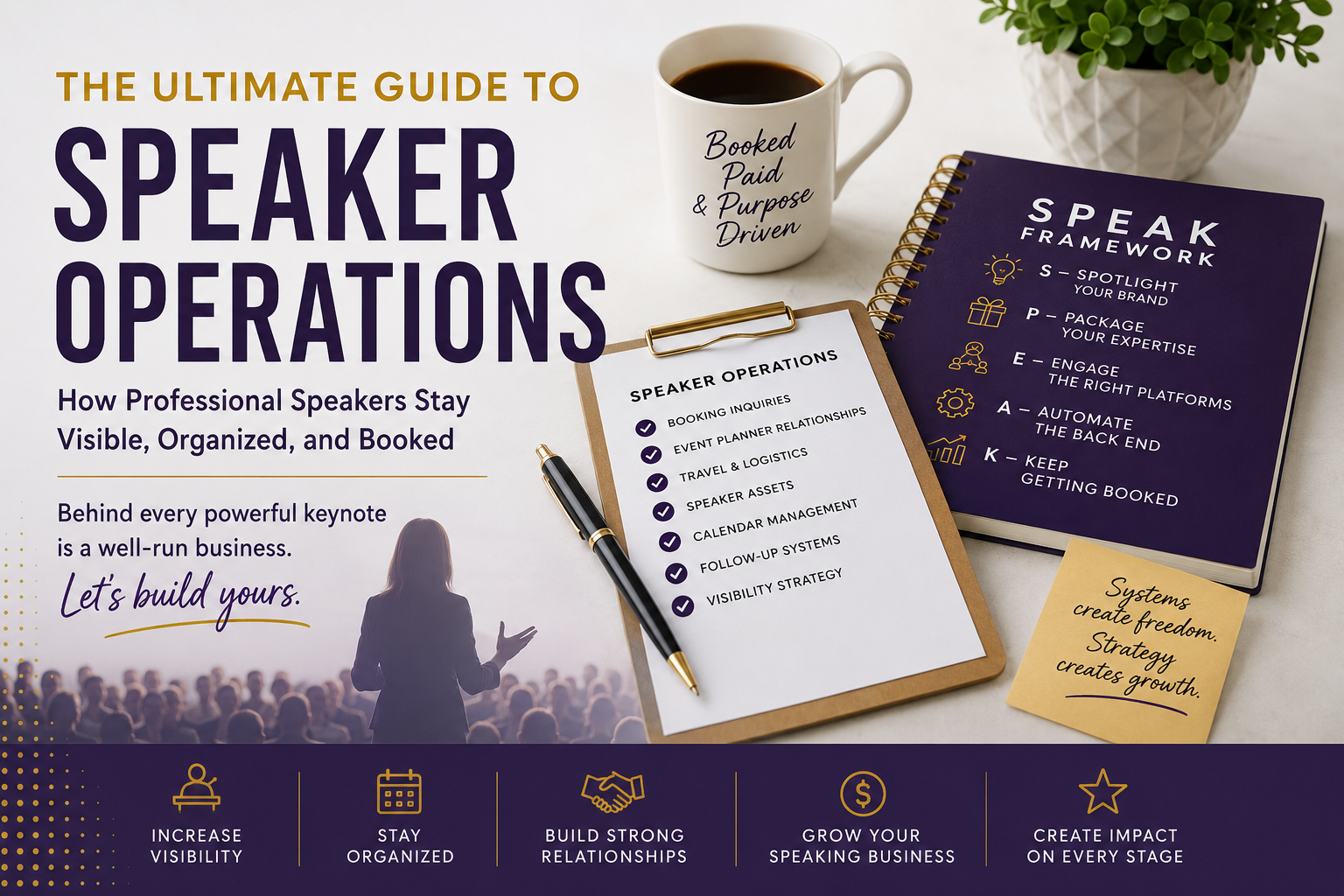
Speaker Operations may include:
- Planner communication
- Speaker materials and asset coordination
- Engagement timelines and deadlines
- Pre-event calls
- Calendar coordination
- Travel and hotel details
- AV and room requirements
- Event itineraries
- Schedule changes
- On-site coordination
- Post-event follow-through
- Testimonial requests
- Planner relationship management
For example, major event-management platforms recognize how much coordination surrounds professional speakers. Cvent provides systems specifically for managing speaker logistics and deliverables, including headshots, bios, presentations, registration, travel details, tasks, and deadlines.
Ultimately, Speaker Operations is the engine running behind the engagement while you focus on being the speaker the organization hired.
Why Successful Speakers Become Overwhelmed
Many speakers start their businesses doing everything themselves. At first, that makes perfect sense.
You’re building the business and learning the industry. Perhaps you only have a few engagements on your calendar.
Therefore, managing every detail yourself may not feel overwhelming.
Then something wonderful happens.
The business grows.
Suddenly, you’re speaking more often and traveling more. You’re also serving corporate clients, preparing customized presentations, writing, creating intellectual property, and developing relationships.
At the same time, every new speaking engagement brings another planner, timeline, set of requirements, and collection of details that somebody has to own.
Unfortunately, that somebody is often still you.
Growth Changes the Question
At this stage, the question needs to change.
Instead of asking:
“Can I handle this myself?”
Ask:
“Should I still be the person handling this?”
Of course you can send your bio or confirm the hotel. Likewise, you can track another deadline or answer another planner email.
However, being capable of doing something doesn’t mean it remains the best use of your time.
As the person responsible for delivering the keynote and growing the business, your attention has greater value elsewhere.
More Bookings Can Expose Weak Operations
It’s easy to assume that more bookings automatically mean your speaking business is becoming stronger.
However, more bookings can also expose weaknesses in the way the business operates.
For example, one engagement with twenty moving pieces may be manageable. Now imagine three engagements happening within ten days.
There are three event planners, three itineraries, three sets of deadlines, and three sets of travel arrangements.
In addition, there may be three different AV requirements and several pre-event conversations.
Each organization expects a polished professional experience.
Meanwhile, you’re preparing presentations and traveling between cities.
This isn’t simply a time-management problem.
It’s a capacity problem.
Your speaking career has grown. As a result, the operations behind it need to grow too.
What Event Planners Really Experience
Event planners hire you because of what you can deliver onstage.
However, their experience with you begins long before you walk onto that stage.
They notice your communication and responsiveness. In addition, they experience your preparation and whether materials arrive on time.
Planners also notice whether requirements are clear and questions are answered.
Most importantly, they experience whether the engagement feels organized.
Then comes the event itself.
Afterward, they experience your follow-through.
That’s why I often remind speakers:
Your keynote happens onstage. Your reputation is built before, during, and after it.
I’ve written more about what event planners remember long after your keynote is over because the planner experience can become an important part of how your speaking business is remembered.
Ultimately, a brilliant keynote combined with a smooth professional experience is a powerful combination.
Five Systems Every Established Speaker Needs
Good Speaker Operations doesn’t require complicated systems.
Instead, it means making sure the important parts of every engagement have somewhere to live and someone responsible for them.
- Engagement Management System
Every confirmed engagement should have one central location for important details.
For example, you may need the organization name, planner contact information, event date, location, fee, contract status, deadlines, travel information, pre-event meetings, and follow-up details.
As a result, you shouldn’t have to search through dozens of emails to figure out what a planner said three weeks ago.
- Speaker Asset System
Your frequently requested speaker materials should be current, organized, and easy to access.
For instance, your files may include your bio, headshots, one-sheet, speaker introduction, keynote descriptions, AV requirements, testimonials, demo reel, book information, and presentation files.
The goal is simple:
When the planner asks, the materials are ready.
- Deadline and Calendar System
A keynote isn’t simply one date on the calendar.
In fact, multiple deadlines may be attached to one engagement.
Materials may be due weeks before the event. Additionally, you may have a pre-event call, travel dates, rehearsal, sound check, reception, keynote, book signing, or workshop.
Therefore, those details need to be tracked before they become last-minute emergencies.
- Planner Communication System
Event planners shouldn’t have to chase down information.
Instead, there should be a clear process for answering questions, providing materials, confirming details, and handling changes.
Furthermore, someone needs to own that process.
This becomes especially important when you’re traveling or preparing for another engagement.
- Post-Event Follow-Through System
The engagement doesn’t end when you leave the stage.
For example, was feedback collected? Was a testimonial requested? Was the planner thanked?
Perhaps you also promised resources that need to be delivered.
In addition, another department may benefit from your message. The keynote could potentially lead to a workshop, leadership retreat, future conference, or referral.
Therefore, a great engagement deserves more than a quick thank-you followed by silence until next year.
The Hidden Cost of Doing Everything Yourself
Poor Speaker Operations has a cost.
However, that cost isn’t always obvious on a financial statement.
The Cost to Your Time
Every hour spent tracking details is an hour you aren’t spending preparing, creating, building relationships, selling, or developing the business.
Therefore, the issue isn’t simply whether you can complete the task. The issue is what that task prevents you from doing instead.
The Cost to Your Capacity
If every booking adds more work directly to your plate, eventually you’ll reach a limit.
As a result, growth can start feeling like a burden rather than an opportunity.
The Cost to Your Planner Experience
Delayed materials, missed details, scattered communication, and last-minute responses affect the planner experience.
Consequently, operational problems can influence how easy or difficult it feels to work with you.
The Cost to Your Follow-Through
Once you’re focused on the next event, the previous engagement can quickly move to the back of your mind.
Therefore, valuable relationships and follow-up opportunities can fall through the cracks.
The Cost to Your Growth
A business that depends on you personally touching every detail becomes harder to grow.
Ultimately, you haven’t created more capacity.
You’ve created more work.
The Difference Isn’t Talent. It’s Infrastructure.
Consider two equally talented keynote speakers charging the same speaking fee.
Both are busy and travel regularly. Furthermore, each delivers excellent presentations.
Speaker A personally manages planner emails, deadlines, travel details, calendar updates, material requests, changes, and follow-up.
By contrast, Speaker B has someone overseeing the operations surrounding each engagement.
Same Talent, Different Business
When Speaker A gets another booking, the first thought may be:
“Great. Now I have twenty more things to do.”
Speaker B has a different experience. Because the process behind the engagement is already moving, this speaker can concentrate on preparing and delivering.
The talent may be equal.
However, the operating models are completely different.
The difference isn’t talent. The difference is infrastructure.
Speaker Operations and the SPEAK Framework
My SPEAK Framework looks at the complete business surrounding a speaker’s expertise.
S: Spotlight Your Brand
Your brand helps organizations understand who you are, what you speak about, and the value you bring.
Therefore, your positioning should reflect the professional level you’ve reached.
P: Package Your Expertise
Your keynote, workshops, books, and intellectual property need clear packaging.
As a result, organizations can more easily understand how you can serve their audiences.
E: Engage the Right Platforms
Your professional presence should support the level of speaking business you’ve built.
In other words, your business should look and operate like the professional enterprise it has become.
A: Automate the Back End
This becomes increasingly important as your speaking volume grows.
For example, engagement processes, deadlines, materials, communication, calendars, logistics, and follow-through shouldn’t depend on you remembering every detail.
K: Keep Getting Booked
A successful engagement can create relationships that extend beyond one keynote.
Therefore, strong follow-through, planner relationships, testimonials, referrals, and repeat opportunities matter.
Why the Back End Matters More as You Grow
For an established speaker, the operational side becomes increasingly important.
At this level, getting booked isn’t the only goal anymore.
Your business needs to be able to handle being booked.
Speaker Operations in Action
The concept becomes clearer when you see how Speaker Operations affects real situations.
Scenario 1: The Overwhelmed Keynote Speaker
This speaker has several upcoming engagements.
However, evenings are spent answering planner emails, coordinating travel, sending materials, updating the calendar, and checking deadlines.
The problem isn’t a lack of ability.
Instead, the speaker is still personally responsible for all of it.
Speaker Operations solution: Create one engagement-management process and transfer ownership of the operational details surrounding each booking.
Scenario 2: The Back-to-Back Speaker
Imagine three engagements in ten days across three cities.
Each engagement has a different planner and its own requirements.
Ideally, this speaker should be preparing presentations, protecting energy, and getting ready to serve three audiences.
Instead, the speaker is trying to remember which planner needs the introduction and whether the next hotel confirmation arrived.
Speaker Operations solution: Centralize planner communication, travel details, deadlines, materials, itineraries, and changes.
Scenario 3: The Growth-Minded Speaker
This speaker has built a strong reputation and wants to continue growing.
However, every new booking adds another pile of work directly to the speaker’s plate.
Eventually, the realization comes:
“I don’t need fewer bookings. I need a better way to manage what happens after I get them.”
Exactly.
Speaker Operations solution: Build infrastructure that allows the business to grow without requiring the speaker to personally manage every moving piece.
What Does a Speaker Operations Strategist Do?
This is where my work comes in.
I’m Deborah Northcutt, Speaker Operations Strategist and founder of The Northcutt Speaking Agency.
I work with established keynote speakers who are already getting booked and paid. However, they’ve reached the point where personally managing everything surrounding their engagements no longer makes business sense.
Once the booking happens, I step in behind the scenes.
What I Manage After the Booking
Depending on the engagement and the speaker’s needs, I may coordinate speaker materials, track deadlines, organize travel information, confirm AV requirements, maintain engagement calendars, prepare itineraries, manage event details, and oversee post-event follow-through.
In addition, I communicate with event planners and help keep planner relationships moving smoothly.
I don’t replace the speaker.
Instead, I protect the speaker’s capacity to do the work only the speaker can do.
That means preparing, delivering, connecting, creating, building relationships, and growing the business.
Imagine Getting Booked Without Getting Another Job
Now imagine receiving an exciting booking without immediately creating another personal to-do list.
The planner needs your materials?
Handled.
Next, a deadline is approaching?
Handled.
Perhaps the pre-event call needs to be scheduled.
Handled.
Then the travel details change.
Handled.
Meanwhile, you’re preparing for tomorrow’s keynote and another planner has a question.
Handled.
Finally, the event ends and follow-through still needs to happen.
Handled.
What Changes When Someone Else Owns the Details?
First, you don’t need to carry every engagement detail in your head.
Second, you don’t need to be the only person who knows what’s happening.
More importantly, you don’t need to personally touch every moving piece simply because you’ve always done it that way.
You built the speaking career.
Now the operations behind it need to support the level you’ve reached.
You Got the Booking. I Handle What Happens Next.
Success in professional speaking isn’t only about getting onto more stages.
Instead, it’s also about building a business capable of supporting the stages you’re already getting.
The more successful your speaking career becomes, the more important the operations behind it become.
Therefore, if you’re an established keynote speaker who’s already getting booked and paid but you’re tired of personally managing everything surrounding those engagements, that’s where I come in.
You focus on the stage. I’ll manage what happens around it.
Ready to Stop Managing Every Detail Yourself?
Let’s talk about what’s happening behind your speaking engagements and where Speaker Operations could give you back capacity.
Schedule a Speaker Operations Strategy Call:
bit.ly/workwithdeborah
About Deborah Northcutt
Deborah Northcutt is a Speaker Operations Strategist and founder of The Northcutt Speaking Agency.
She works with established keynote speakers who are already getting booked and paid. However, these speakers have reached the point where personally managing every moving piece surrounding their engagements no longer makes business sense.
From planner communication and speaker materials to event logistics, deadlines, coordination, and post-event follow-through, Deborah manages what happens after the booking.
As a result, speakers can stay focused on delivering their keynotes and growing their businesses.
You got the booking. Deborah handles what happens next.

0 Comments